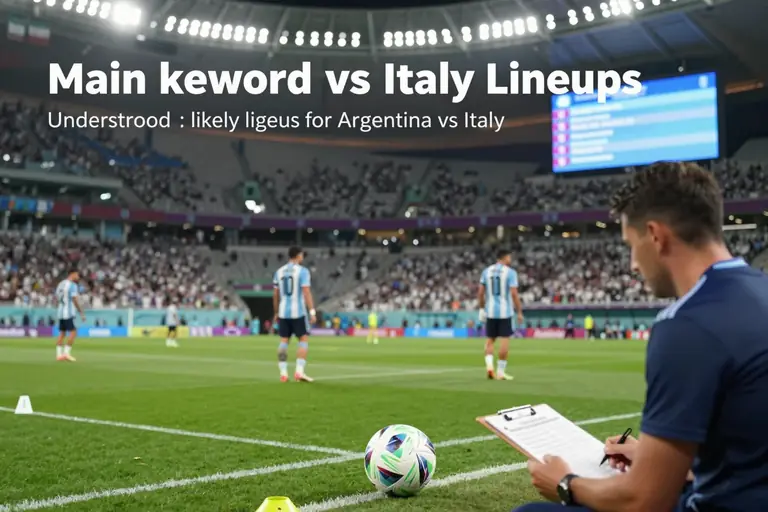
When footballing giants Argentina and Italy face off, anticipation is high. Beyond the rivalry and talent, pre-match buzz focuses on starting lineups. For nations steeped in rich footballing traditions, player selection and formation are strategic declarations dictating the match’s flow and outcome. This article explores expected setups, pivotal players, and tactical nuances that could swing the game, offering insight into tactical battles, individual duels, and potential game-changing moments.
Expected Formations and Key Players for Argentina
Under Lionel Scaloni, Argentina is formidable, blending defensive resilience and attacking brilliance. Their tactical flexibility often sees them oscillate between a 4-3-3 and a 4-4-2, adapting to exploit weaknesses or solidify their structure. Their strategy centers on world-class talent and cohesive team play.
Lionel Messi is the focal point, often operating from the right wing with freedom to drift centrally, orchestrate play, create chances, and score. Lautaro Martinez is a strong contender for central striker, known for predatory instincts, intelligent movement, and aerial prowess. Angel Di Maria provides width and creativity on the opposite flank, delivering dangerous crosses and cutting inside.
In midfield, Rodrigo De Paul is indispensable with his boundless energy and box-to-box capabilities. Leandro Paredes anchors, dictating tempo and shielding the defense. Enzo Fernandez adds control and creativity. The defense typically features Nicolas Otamendi and Cristian Romero at center-back, with Nahuel Molina and Marcos Acuña offering dynamism from full-back. Emiliano Martinez provides the last line of defense with his shot-stopping and leadership.
Expected Formations and Key Players for Italy
Italy, under their current coaching setup, consistently showcases tactical discipline, technical proficiency, and collective spirit. They commonly deploy a 4-3-3 or a 4-2-3-1, emphasizing quick transitions, intelligent pressing, and a midfield that controls possession.
The Italian midfield is often the heart of their team. Jorginho, with his exceptional passing range, dictates tempo. Nicolo Barella provides dynamism and defensive work rate. Manuel Locatelli or Sandro Tonali might feature, offering defensive solidity and creative passing. This trio forms a formidable unit.
Upfront, Italy boasts a versatile forward line. Federico Chiesa is a constant threat with his pace and direct dribbling. Domenico Berardi or Gianluca Scamacca could lead the line, offering different profiles. Options like Giacomo Raspadori or Mateo Retegui provide versatility. The defense is historically robust. Alessandro Bastoni or Francesco Acerbi could partner with a strong center-back, while Giovanni Di Lorenzo and Federico Dimarco offer defensive solidity and attacking impetus from full-back. Gianluigi Donnarumma is a world-class goalkeeper.
Tactical Considerations and Key Player Roles
Lineup selection is about how each player fits into a tactical scheme. For Argentina, attacking players are paramount. Messi’s ability to unlock defenses is complemented by full-backs pushing high and central midfielders making late runs. Defensive midfielders shield the back four, break up play, and initiate counter-attacks.
Italy’s approach prioritizes control and precision. Midfielders maintain possession, recycle the ball, and break down opponent plays. Wingers provide pace and directness, frequently cutting inside or linking with the striker. Defensively, their system relies on disciplined positioning, aggressive pressing, and understanding between the back four and midfield. Full-backs provide offensive support.
In such a clash, the midfield battle is decisive. The team asserting dominance in the center of the park – winning possession, distributing to dangerous zones, and stifling opponent creativity – gains a significant advantage, controlling tempo and dictating attacks and defensive transitions.
Potential Surprises and Adaptations
Football is a game of strategy and adaptation. Coaches spring surprises due to injuries, tactical adjustments, or in-form players. For Argentina, a 5-3-2 might bolster defense against Italy’s wide attacks or match their midfield numerically, providing defensive solidity and counter-attack outlets.
Italy might opt for a more defensive setup, absorbing pressure and counter-attacking with pace. A 3-5-2 could pack the midfield and defense, making them harder to break down. Player fitness is crucial; a last-minute injury can disrupt the XI. Coaches also consider player form; an in-form player might start over an established name. These decisions can be the difference between victory and defeat.
As in a Brazil vs England Prediction, tactical choices and player selections are critical. Managers meticulously plan, often keeping cards close to their chest until the last moment.
Final Thoughts on Lineup Impact
The unveiling of Argentina vs Italy lineups will be intensely scrutinized. Every player chosen, every formation deployed, carries significant weight. While we anticipate patterns based on past performances and philosophies, football’s beauty lies in unpredictability. The starting XI sets the stage, but individual brilliance, in-game tactical adjustments, and player determination ultimately decide the result. Even with careful planning, the unexpected often triumphs.
Remember, sports betting should always be approached responsibly. Only wager what you can afford to lose, and never chase losses.
FAQ
How do coaches decide on their starting lineups for big international matches?
Coaches consider player form and fitness, tactical suitability against the opponent, past performance in high-stakes games, and team chemistry. They review injury reports, analyze club performances, and factor in disciplinary records or travel fatigue.
What role do substitutes play in a match like Argentina vs Italy?
Substitutes are crucial strategic tools. They make tactical changes, introduce fresh legs, address injuries, or inject a different dynamic. A well-timed substitution can alter momentum and be decisive in close contests.
Are there common formations used by top international teams?
Yes, common formations include 4-3-3 (attacking width, strong midfield), 4-2-3-1 (creative attacking midfielder), 4-4-2 (defensive solidity, two strikers), and 3-5-2 (strong central defense and midfield with wing-backs). Choice depends on personnel, coaching philosophy, and tactical plan. Many teams show flexibility, adapting during a match.